

Driving in Mallorca is easy once you know a handful of local rules. Drive on the right, overtake on the left. Speed limits run from 20 km/h in tight one-lane town streets up to 120 km/h on motorways, and speed cameras are common on routes like the Ma-1 and Ma-10. The drink-drive limit is 0.5g/litre blood alcohol (lower for new drivers). EU licence holders can drive with no extra paperwork; most non-EU visitors can too, though a paper licence or one issued outside the EU/EFTA may require an International Driving Permit (IDP). To hire a car you must be at least 21 and have held a licence for a year or more. Parking is colour-coded: white is free, blue is paid (zona azul), green is residents-only, and yellow means don’t stop. Avoid driving into Palma’s historic ACIRE zone — camera-enforced and residents-only — and check Palma’s and Sóller’s low-emission zone (ZBE) rules before heading into town. There are no toll roads on the island. Fines from a rental car are passed on to the driver by the hire company, so it pays to know the rules before you set off. Ready to book? See our car hire FAQs or go straight to hire a car with Mallorca Car Hire Company.
Why the same driving questions come up every season
Every year, as the same flights land at Palma Airport, the same questions land in our inbox and across forums like Reddit’s r/mallorca: what side of the road is it, what do the painted colours on the parking bays mean, do I need a special permit, and what happens if I get a ticket in a hire car? These aren’t silly questions — Mallorca’s driving rules follow Spanish national law but have a few island-specific quirks that catch first-time visitors out, from the residents-only zone in Palma’s old town to the mountain hairpins of the Serra de Tramuntana. Below, we’ve answered the questions we hear most, backed by current Spanish traffic law (DGT) and 2026 local updates, so you can pick up your rental with confidence.
What side of the road do you drive on in Mallorca?
Like the rest of mainland Spain, Mallorca drives on the right-hand side of the road, and overtaking is done on the left. If you’re used to driving on the left (UK, Ireland, Australia and others), give yourself a day to adjust, particularly at roundabouts and junctions where muscle memory can pull you the wrong way. Most visitors find it easier than expected, especially since indicators, pedals and gear layout in a hire car are identical to home — it’s really just the road position that changes.
What are the speed limits in Mallorca?
Speed limits are lower in town than many visitors expect, and enforcement is active. As of 2026, the limits are:
20 km/h on urban streets with a single lane shared by both directions
30 km/h on urban roads with one lane in each direction
50 km/h on urban roads with two or more lanes each way
90 km/h on rural roads outside towns
100 km/h on multi-lane roads
120 km/h on motorways (autopistas)
Speed cameras and average-speed systems are widely used on routes such as the Ma-1 (Palma–Andratx), the Ma-10 through the Tramuntana, and the Ma-13 and Ma-19 motorways, with both fixed cameras and mobile radar units. Fines for speeding typically range from €100 to €600 depending on how far over the limit you’re caught, with steeper penalties the faster you’re going relative to the posted limit.
Do I need an International Driving Permit (IDP) to drive in Mallorca?
It depends on where your licence was issued. Licences from EU and EEA countries (including Iceland, Liechtenstein and Norway) are valid in Spain with no extra documentation. UK licence holders can generally drive on their standard photocard licence for short visits, since the UK remains on the Vienna Convention list — but an old-style paper licence, or one issued in Gibraltar, Guernsey, Jersey or the Isle of Man, is likely to need an IDP. Visitors from other non-EU/EFTA countries (the US, Canada, Australia and others) can typically use their home licence for up to six months, though carrying an IDP alongside it is strongly recommended and, in some cases, required. Rules can shift, so check current requirements before you travel — and remember to always carry your original licence, not just the IDP, since the permit is only valid alongside it.
What’s the minimum age to hire a car in Mallorca?
Across the industry, the standard minimum is 21 years old, with most companies also requiring that you’ve held a full driving licence for at least one to two years. At Mallorca Car Hire Company, the minimum age is 21 with at least one year’s driving experience, and — unlike many larger operators — we don’t charge young driver surcharges for renters under 25. Full details on age requirements, including options for senior drivers, are in our car hire FAQ.
What documents do I need to hire and drive a car in Mallorca?
You’ll need a valid driving licence, a form of ID (passport for non-Spanish residents), your booking confirmation and a payment method. Non-EU drivers should also carry an IDP where required (see above). While driving, Spanish law requires you to keep your licence, vehicle registration and insurance documents accessible in the car at all times — a hire car will have these ready for you, but it’s worth checking before you drive off. Spanish-registered vehicles must also carry a high-visibility vest, and 2026 rules are phasing in V16 flashing beacons in place of the old warning triangles for local cars — though visitors driving temporarily in Spain, including most rental cars, can still rely on standard triangles.
What’s the drink-drive limit in Mallorca?
Spain applies a strict blood alcohol limit of 0.5 grams per litre for most drivers, dropping to a lower limit for novice and professional drivers. Drug-driving carries a zero-tolerance policy. Roadside checks by the Guardia Civil are common, especially on popular routes and around resort areas during peak season, and penalties range from heavy fines and licence points to suspension or, in serious cases, criminal charges. Given how easy it is to enjoy a long lunch with wine in Mallorca, the safest approach if you’re driving is to treat any alcohol as a reason to hand the keys to someone else, or skip driving that day entirely.
How do the parking colour codes work in Mallorca?
Painted kerbs and bays follow a simple colour system used across the island:
White – free parking
Blue (zona azul) – paid parking; pay at the meter or via an app such as EasyPark, and watch the posted time limit, often capped around two hours in busy centres
Green – reserved for local residents
Yellow – no parking or stopping
Fines for parking in the wrong zone typically run from around €40 to €200, and in tourist hotspots like Sóller or Santanyí, wardens do check regularly during market days and peak season. When in doubt, use a signed car park rather than guessing at a kerb colour.
Is it illegal to drive into Palma’s old town? What is the ACIRE zone?
Yes — you should avoid driving into the historic centre of Palma altogether. The old town is protected by camera-enforced “ACIRE” zones (residents-only access), and entering in a rental car without a permit results in an automatic fine by post, often weeks after your trip. Palma’s centre is also compact, pedestrianised in parts, and short on parking, so it’s best explored on foot. We recommend leaving your car at the Parc de la Mar underground car park in front of the Cathedral, or another secure car park such as Passeig de Mallorca, and walking in from there. If your accommodation sits inside an ACIRE zone, you’ll usually need to register your licence plate with the hotel in advance.
What is the ZBE low-emission zone, and does it affect tourists?
Since January 2025, Palma has operated a Zona de Bajas Emisiones (ZBE), restricting older, higher-emission vehicles from parts of the city and requiring online registration for foreign-plated vehicles that qualify to enter. Sóller has introduced a similar low-emission zone covering roughly a dozen streets in its historic centre, with non-resident vehicles directed to designated parking on the outskirts. Most modern hire cars meet emissions requirements, but if you’re bringing your own vehicle from abroad, it’s worth checking your car’s environmental badge and the current zone rules before driving into either town.
Are there toll roads in Mallorca?
No. Mallorca has no toll roads, so you’re free to explore the island’s motorways and country roads without extra charges — just factor in fuel, which is worth topping up before heading into rural areas or the mountains, since petrol stations thin out away from the main towns.
What should I know about roundabouts and right of way?
Vehicles already on a roundabout have priority over those entering, and at unmarked junctions you generally give way to traffic coming from your right unless signs say otherwise. One quirk locals will tell you about: many Mallorcan drivers stay in the outside lane of a roundabout regardless of which exit they’re taking, rather than moving to an inner lane for a later exit — so expect vehicles to cut across in front of you near the exit, and take roundabouts slowly and with your indicators on early. Zebra crossings are sometimes positioned right at roundabout exits, so be ready to stop.
Is the Tramuntana mountain road or Sa Calobra safe to drive?
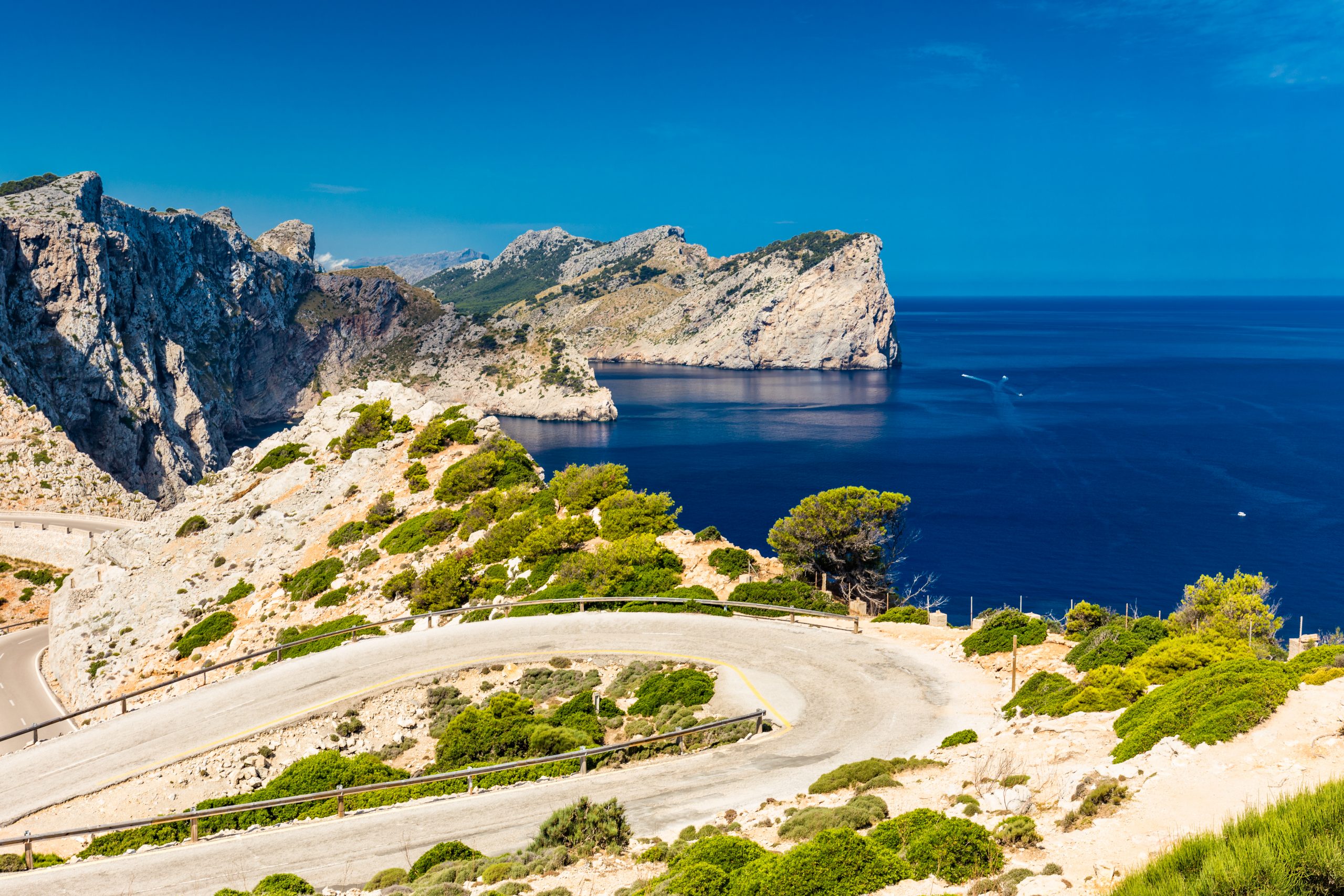
Roads through the Serra de Tramuntana, including the route to Sa Calobra, feature narrow lanes, tight hairpin bends and steep gradients, but they’re entirely manageable at a sensible pace. Stay in a low gear on the switchbacks, keep well to the right, watch for cyclists (Mallorca is a major cycling destination and groups often ride two or three abreast), and never rush a blind corner. Digital information panels introduced in 2025 now show live parking availability in Sóller, Sa Calobra and Cala Tuent, so you can check before you commit to the drive. If mountain driving isn’t for you, most companies including ours can point you to organised tours as an alternative.
What happens if I get a speeding or parking fine in a rental car?
The fine is issued to the vehicle’s registered owner first — in this case, the rental company — who then passes the fine on to whoever was driving at the time, along with an administration fee in most cases. You’ll typically have a set window to pay before penalties increase. This is standard practice across the industry and applies whether the ticket comes from a fixed camera, a mobile radar, or a parking warden. For full details on how this works with us, see our car hire FAQ page.
Can I take my rental car on the ferry to Ibiza, Menorca, or the mainland?
No — with Mallorca Car Hire Company, and with most local operators, your rental agreement and insurance are valid only within Mallorca. Taking a hire car on a ferry to another island or the mainland voids your cover completely. The good news is that Mallorca alone offers more than enough to fill a trip, from the calas of the southeast coast to the villages of the Tramuntana.
What size of car should I hire in Mallorca?
A smaller car is almost always the right call. Many of Mallorca’s most memorable spots — hillside villages, cala approach roads, old-town streets — were never built with large SUVs in mind, and a compact or small hatchback is easier to park, easier to thread through tight lanes, and easier on fuel. If you’re travelling as a family or in a group, a mid-size estate or people carrier still handles the island’s roads comfortably. You can compare vehicle groups and get a quote on our hire a car page.
Quick-reference FAQ
Q: What side of the road does Mallorca drive on?
The right-hand side, with overtaking on the left.
Q: What’s the speed limit in Mallorca?
Between 20–50 km/h in towns depending on lane layout, 90 km/h on rural roads, and up to 120 km/h on motorways.
Q: Do I need an IDP for Mallorca? EU/EEA licence holders don’t.
UK licence holders usually don’t for short stays. Most other non-EU visitors should carry one alongside their home licence.
Q: What’s the minimum age to rent a car?
21, with at least one year of driving experience, at Mallorca Car Hire Company.
Q: Are there tolls in Mallorca?
No.
Q: Can I drive into Palma old town?
It’s best avoided — the ACIRE zone is residents-only and camera-enforced.
Q: What’s the alcohol limit for driving?
0.5g/litre blood alcohol, lower for new and professional drivers.
Ready to explore Mallorca by car?
Knowing these rules before you land takes the stress out of getting behind the wheel, and lets you focus on the drive to Deià, Formentor or your favourite cala instead. Mallorca Car Hire Company offers no-deposit, no-hidden-fee car rental with free airport pick-up at Palma (PMI), free additional drivers, and free child seats on every booking. Browse our full range and get a quote on the hire a car page, or check more answers on our car hire FAQ.
For more detail on some of the specifics covered here, our hire-a-car page has more on driving into Palma’s ACIRE zone, taking your rental car on the ferry to Ibiza or Menorca, and International Driving Permit requirements for non-EU visitors, while our car hire FAQ covers parking in Mallorca in more depth. If you’re still deciding who to book with, take a look at why travellers choose us, and check out the blog for more Mallorca travel tips before your trip.
If you’re mapping out your route, our Ultimate Mallorca Road Trip: 7-Day Itinerary puts these driving rules into practice with a full week of stops around the island, and our Car Hire Mallorca FAQ answers a further 20 questions about picking up your vehicle at PMI. Heading to the coast? Our Best Beaches in Mallorca guide covers the calas and beach roads worth building into your drive.