

A road trip is the best way to see Mallorca in 2026 — mountain villages, hidden cala beaches, and coastal roads that public transport simply can’t reach. Give yourself 5–7 days if you can (3 days covers the highlights, 10 days lets you slow down). The classic route runs Palma → Valldemossa → Deià → Sóller → Sa Calobra → Pollença → Cap de Formentor → Alcúdia → the east coast calas → Es Trenc and the south. Pick up your car near Palma de Mallorca Airport from Mallorca Car Hire Company, and drive the Sa Calobra road early in the morning to beat the coach traffic. Full itinerary and driving rules below.
A road trip around Mallorca is still the best way to experience the island’s mountain villages, turquoise cala beaches, scenic coastal roads, and historic towns — and 2026 is a great year to do it, with several resurfaced stretches on the Ma-10 and steady (not overwhelming) visitor numbers outside peak August weeks. From Palma de Mallorca Airport to the legendary road to Sa Calobra, every route offers something different. In one trip you can visit Valldemossa, Deià, Sóller, Cap de Formentor, Alcúdia, and the best beaches in Mallorca — at your own pace, not a coach tour’s.
With a vehicle from Mallorca Car Hire Company, it’s easy to explore Mallorca at your own pace, discover hidden coves most visitors never see, and build the ultimate Mallorca itinerary around what you actually want to do.
Why a Road Trip Around Mallorca Is the Best Way to Explore Mallorca
Mallorca is much more than a beach holiday destination. It is an island of mountain roads, picturesque villages, hidden coves, stylish boutique towns, and breathtaking coastal scenery.
The best way to get around Mallorca is with your own car. Public transport works in larger towns, but many of the island’s best spots are easier to reach by road. With your own vehicle, you can stop whenever you want, stay longer in your favourite places, and enjoy complete freedom.
That is why visitors choose Mallorca Car Hire Company when planning a trip to Mallorca.
Quick Trip-Planning Snapshot
| Best base for pickup | Palma de Mallorca Airport |
| Minimum days recommended | 3 (5–7 is ideal) |
| Best months to drive | April–June, September–October |
| Toll roads | None on the island |
| Trickiest drive | The Sa Calobra road (hairpins, but fully paved) |
Why a Road Trip Around Mallorca Is the Best Way to Explore the Island
Mallorca is much more than a beach holiday destination. It’s an island of mountain roads, picturesque villages, hidden coves, stylish boutique towns, and coastal scenery that changes completely every 20 minutes of driving.
Public transport works reasonably well between the bigger towns, but many of the island’s best spots — Sa Calobra, Cap de Formentor, the smaller east-coast calas — are only realistically reachable by road, and on your own schedule rather than a bus timetable. With your own vehicle, you can stop whenever a viewpoint catches your eye, stay longer in the places you love, and skip the ones that don’t grab you.
That’s why visitors planning a trip to Mallorca choose Mallorca Car Hire Company — no hidden fees, easy airport collection, and vehicles suited to everything from Palma’s tight old-town streets to the switchbacks above Sa Calobra.
Mallorca Road Trip Itinerary: How Many Days Do You Need?
You can enjoy a Mallorca road trip on almost any length of stay, but more time means less rushing and more time actually sitting on a beach instead of driving past one.
3-Day Mallorca Itinerary — A short break covering Palma, Valldemossa, and Sa Calobra. Good if you’re combining Mallorca with another trip or only have a long weekend.
5-Day Mallorca Itinerary — Enough time to properly cover the mountains, a couple of beach days, and the scenic villages without feeling rushed.
7-Day Mallorca Road Trip Itinerary — The itinerary this guide is built around: the full coast of Mallorca, mountains to the north, beaches to the south, with breathing room each day.
10-Day Mallorca Itinerary — Best for travellers who want proper beach days, extra time in the hidden coves, and a genuinely slow-travel pace.
Day 1: Palma de Mallorca & Airport Car Hire
Most visitors begin their trip in Palma, and it’s the natural starting point for a road trip: central, well-connected to every route on this list, and 15–20 minutes from the airport.
Collect your vehicle from Mallorca Car Hire Company near Palma de Mallorca Airport and start your adventure with total flexibility from hour one.
Best Things to Do in Palma de Mallorca
- Visit La Seu, Palma’s Gothic cathedral, right on the seafront
- Walk the marina and harbour promenade
- Explore the cobbled streets of the old town (Casc Antic)
- Enjoy rooftop dining with cathedral or bay views
- Shop the local boutiques around Carrer de Sant Miquel
- Relax in the lively plazas as the evening cools down
Palma is the perfect first stop before heading into the mountains — spend the afternoon here, then start early the next morning to beat the traffic on the coast road.
Day 2: Valldemossa, Frédéric Chopin, George Sand & Cala Deià
Roughly 45–60 minutes total driving today, spread across two stops.
This is one of the most picturesque drives on the island, climbing straight into the Serra de Tramuntana within half an hour of leaving Palma.
Stop 1: Valldemossa – Mallorca’s Famous Mountain Village
Valldemossa is one of the most visited places in Mallorca, known for its stone houses, cobbled streets, and mountain scenery. It sits about 17km from Palma — around a 25-minute drive on the Ma-1110.
Why Visit Valldemossa?
- Charming, well-preserved village atmosphere
- The Royal Carthusian Monastery (Reial Cartoixa)
- Great cafés for a mid-morning coffee stop
- Flower-filled lanes that make for the best photos on the island
- Sweeping views back down toward the coast
Frédéric Chopin & George Sand in Valldemossa
Valldemossa became internationally famous when the composer Frédéric Chopin and writer George Sand spent the winter of 1838–39 here, staying in cells at the old Carthusian monastery. Chopin composed several of his Preludes during this stay, and Sand later wrote about the trip in A Winter in Majorca. Their time in the village is a big part of why Valldemossa remains one of the island’s most iconic cultural destinations, and the monastery cells are open to visitors today.
Stop 2: Cala Deià – Boutique Cove Along the West Coast
A short drive from the village of Deià — about 10km and 15 minutes from Valldemossa — is Cala Deià, one of the most beautiful cove beaches in Mallorca.
Why Visit Cala Deià?
- Rocky swimming cove with genuinely clear water
- Boutique, low-key atmosphere (this isn’t a resort beach)
- Excellent seafood restaurants right on the water
- A natural, scenic stop along the west coast route
Day 3: Sóller, Port de Sóller & Fornalutx in the Tramuntana Mountains
Today you go deeper into the Serra de Tramuntana, Mallorca’s UNESCO World Heritage mountain range, which runs the length of the island’s northwest coast.
Stop 1: Sóller – Main Square, Orange Groves & Historic Charm
About 10km and 20 minutes from Deià, Sóller is one of the most popular towns in the Tramuntana mountains, sitting in a valley famous for its orange and lemon groves.
Highlights of Sóller
- Elegant main square (Plaça de la Constitució)
- Traditional cafés serving fresh-squeezed orange juice
- The historic wooden tram connecting Sóller to Port de Sóller
- Orange and citrus groves surrounding the town
- Stylish old streets with modernista architecture
Stop 2: Port de Sóller – Coastal Day Trip Stop
Just a short drive — or a ride on the vintage tram — from Sóller is Port de Sóller.
Why Visit Port de Sóller?
- A beautiful, sheltered horseshoe bay
- Sandy beach right along the promenade
- Seafront restaurants for a long lunch
- Family-friendly waterfront walk
- A relaxed contrast to the mountain driving
Stop 3: Fornalutx – Picturesque Village in the Mountains
About 7km and 15 minutes from Sóller, Fornalutx is often ranked among Spain’s prettiest villages and is a must-see stop.
Why Visit Fornalutx?
- Steep stone stairways between honey-coloured houses
- Peaceful, near-silent lanes even in high season
- Some of the best mountain views on the island
- A genuinely authentic village feel, without the coach-tour crowds
Day 4: The Road to Sa Calobra & Torrent de Pareis
No Mallorca road trip is complete without driving the legendary road to Sa Calobra.
Why the Road to Sa Calobra Is Famous
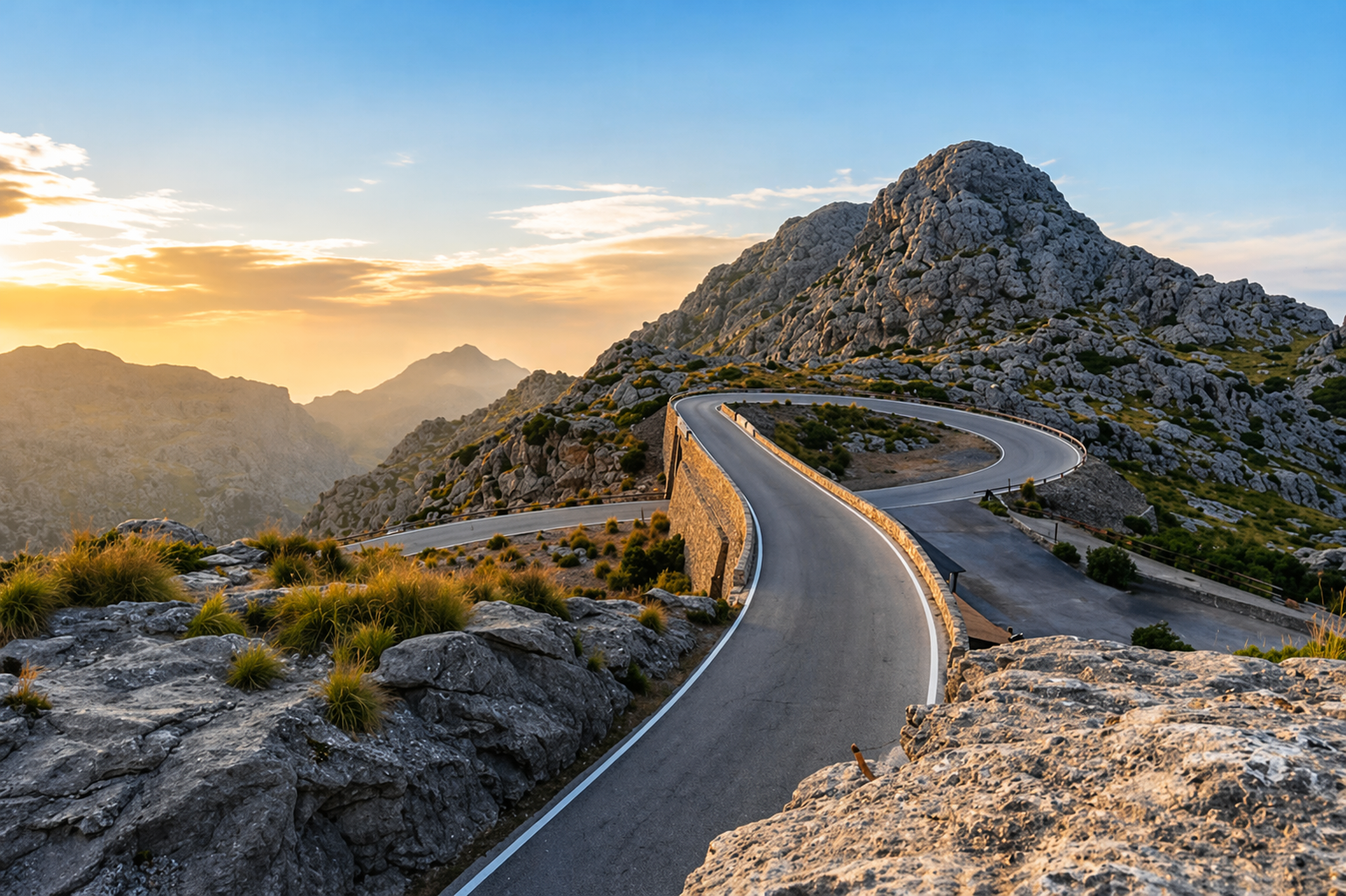
The road down to Sa Calobra (the Ma-2141) is one of Europe’s most spectacular mountain roads, built in the 1930s and dropping around 800 metres in elevation over roughly 12km of hairpin bends — including the famous “Nus de sa Corbata” (tie-knot), a full 270-degree loop the road makes to lose height without an impossible gradient.
What Makes It Special?
- A genuinely dramatic mountain road, not an exaggeration for tourists
- Famous switchbacks and the tie-knot loop
- Stunning viewpoints over the Tramuntana coastline
- An exciting but manageable drive
- Direct access to one of the island’s most remote beaches
Driving the Road Down to Sa Calobra
Take your time and enjoy every turn — this is one drive where the journey really is the point. The route is fully paved, but it’s narrow, winding, and shared with cyclists and the occasional coach, so it requires careful, unhurried driving. Arriving before 9:30am (especially in summer) makes a real difference, since the road and car park get busy once the tour boats and coaches from Port de Sóller arrive.
With a comfortable, manoeuvrable vehicle from Mallorca Car Hire Company, the drive is smooth and genuinely enjoyable rather than stressful.
Torrent de Pareis – Mallorca’s Natural Wonder
At the bottom of Sa Calobra, walk through the short rock tunnel to reach Torrent de Pareis, one of Mallorca’s most famous natural landmarks — a dramatic gorge carved between two towering limestone cliffs, where a rocky riverbed meets the sea.
Why Visit Torrent de Pareis?
- Towering limestone cliffs on either side
- Unique, dramatic rock formations
- Clear turquoise water where the gorge meets the sea
- Genuinely incredible photo opportunities
This is one of the true must-see spots on the island, and one of the very few places on this itinerary where the drive itself is as memorable as the destination.
Day 5: Pollença, Cap de Formentor & the North of the Island
Today you explore the north of the island, finishing at the northernmost point of Mallorca.
Stop 1: Pollença – Historic Streets & Local Charm
Pollença is a classic Mallorcan town full of culture and character, roughly 30–40 minutes’ drive from the Sóller side of the island.
What to Do in Pollença
- Visit the main square and market (Sunday mornings especially)
- Walk the cobbled streets of the old town
- Climb the 365 Calvari steps for views over the rooftops
- Enjoy the cafés and boutiques around Plaça Major
Stop 2: Cap de Formentor – Northernmost Point of Mallorca
Cap de Formentor is one of the island’s most breathtaking places, about 20km and 30–40 minutes of winding coastal road from Pollença.
Why Visit Cap de Formentor?
- Dramatic cliffs dropping straight into the Mediterranean
- The 19th-century lighthouse at the tip of the cape
- Some of the best sea panoramas on the island
- A genuinely excellent sunrise spot, if you’re up for the early drive
- Incredible views back over the whole northern coastline
The drive north to Formentor is one of the best scenic routes on the Balearic Islands — narrow in places, so give yourself extra time and expect to slow for cyclists.
Day 6: Alcúdia & the Best Sandy Beach Stops
After a few days of mountain roads, today is all about beach time.
Stop 1: Alcúdia Old Town
Alcúdia is one of the most beautiful historic towns in Mallorca, still partly enclosed by its original Roman and medieval walls.
Why Visit Alcúdia?
- Well-preserved ancient walls and gates
- Traditional plazas and a lively Tuesday/Sunday market
- Great shopping in the old town
- Family-friendly restaurants around the centre
Stop 2: Playa de Alcúdia – Best Sandy Beach in Mallorca
This long, sweeping beach is one of the top family beaches on the island, stretching several kilometres along Alcúdia Bay.
Why It’s Popular
- Soft, fine sand
- Turquoise, shallow water — ideal for families
- Good range of watersports available
- Easy car park access right along the beach road
For a full rundown of the island’s coastline beyond this itinerary, our best beaches in Mallorca guide covers the hidden coves as well as the popular spots.
Day 7: East Coast Cala Beaches & Hidden Coves
Mallorca’s east coast is known for small, turquoise cala beaches tucked between pine-covered cliffs.
Cala Varques – Natural Cove Adventure
A more untouched beach, ideal for those wanting nature over amenities — there’s no beach bar here, so bring water and supplies.
Why Visit?
- Genuinely clear water
- A quiet, unspoilt setting
- Great snorkelling among the rocks
- Natural, undeveloped scenery
Cala Mondragó – Family-Friendly Cala Beach
One of the easiest and most beautiful beaches in Mallorca to visit with kids, protected within the Mondragó Natural Park.
Why Visit Cala Mondragó?
- White sand and calm, gentle water
- Protected nature park setting
- Good facilities without feeling overdeveloped
- Great for families with younger children
Cala d’Or – Stylish Resort & Places to Stay in Mallorca
Cala d’Or is ideal if you’re looking for stylish coastal stays to break up the road trip.
Why Stay in Cala d’Or?
- Marina restaurants right on the water
- A good range of boutique hotels
- Relaxed evening atmosphere
- A great base for exploring the surrounding east coast calas
Day 8: Es Trenc, Santanyí & South Coast Mallorca Beaches
Es Trenc – Famous Beach in Mallorca
Es Trenc is one of the most famous beaches in Mallorca and is often compared to the Caribbean for its colour — protected coastline means it’s stayed largely undeveloped.
Why Visit Es Trenc?
- A long, genuinely sandy beach
- Striking turquoise water
- A protected, natural setting (limited development by law)
- A relaxed atmosphere even in peak season
Santanyí – Boutique Town & Best Way to Explore Local Mallorca
End your trip in Santanyí, one of the island’s most elegant inland towns, built from the same golden sandstone as Palma’s cathedral.
Why Visit Santanyí?
- The Wednesday and Saturday local market
- Stylish boutiques and galleries
- Beautiful honey-coloured stone streets
- An authentic, local atmosphere away from the coast
Best Scenic Roads Around Mallorca
If you love driving, these are the routes worth building your itinerary around.
Ma-10 Road Along the West Coast — The most famous road on the island, running the length of the Tramuntana mountains from Andratx to Pollença.
Road to Sa Calobra (Ma-2141) — The island’s most exciting and technical drive.
Cap de Formentor Road (Ma-2210) — One of the best routes in the north of the island, cliffside the whole way.
Coastal Roads Around Mallorca — The smaller roads linking the east and south coast calas, ideal for relaxed scenic day trips at a slower pace.
Driving in Mallorca: Rules & Safety Basics
Mallorca is an easy island to drive around — roads are generally well-maintained and there are no toll roads anywhere on the island — but it’s worth knowing the basics before you set off.
Speed limits: 50 km/h in towns (down to 20–30 km/h on some single-lane urban streets), 90 km/h on rural roads, and 120 km/h on motorways. Speed cameras and average-speed checks are common on the main routes, so don’t assume mountain roads are unmonitored.
Parking colours: white lines mean free parking, blue (zona azul) means paid parking by meter or app, green is residents-only, and yellow means no stopping. Parking in the wrong zone can result in a fine, so check the kerb markings before you leave the car.
Documents to carry: a valid driving licence, ID or passport, your booking confirmation, and a payment method. UK licence holders don’t generally need an International Driving Permit for short stays; most other non-EU/EEA visitors should carry one to be safe.
Alcohol limit: 0.5g/litre blood alcohol for most drivers — noticeably stricter than some other countries, so plan accordingly if you’re stopping at wineries or beach bars.
This covers the essentials for a road trip, but for the full breakdown of fines, low-emission zones in Palma and Sóller, and mountain-road specifics, see our complete guide to driving in Mallorca.
Why Rent a Car in Mallorca?
Many travellers ask if they should rent a car for their trip. If you want freedom, easy beach access, mountain villages, and hidden coves, the answer is yes.
Explore Mallorca Freely — Stop wherever a view or a cove catches your eye.
Reach the Best Spots — Many of the island’s best beaches and villages are only realistically reachable by car.
Save Time — No waiting for buses that run once an hour outside peak season.
Better Comfort — Travel with luggage and beach gear without depending on connections.
Easy Airport Collection — Pick up near Palma de Mallorca Airport and start immediately.
That’s why visitors trust Mallorca Car Hire Company for their Mallorca road trip.
Best Time to Visit Mallorca
Spring — Perfect driving weather and the greenest scenery of the year, as the almond and citrus blossoms come through.
Summer — Hot beach season, lively towns, but the busiest roads and car parks — expect Sa Calobra and Formentor to be busy by mid-morning.
Autumn — Warm sea, fewer crowds, and some of the best light for photography on the coastal drives.
Winter — Peaceful roads, calm villages, and mountain scenery few visitors see — some smaller coastal restaurants close, so plan accordingly. It’s also worth checking our Mallorca events guide before you travel, since local festivals can affect town parking and road closures on specific dates.
Travel Tips for Your Mallorca Trip
- Book your hire car early for summer travel, especially in July and August
- Start scenic drives (Sa Calobra, Formentor) early to beat the coach traffic
- Park before the busy midday hours in popular towns
- Bring water for beach stops without facilities, like Cala Varques
- Respect cyclists on mountain roads — the Tramuntana is a major cycling destination
- Plan extra time for photo stops; the drives are half the point
Final Thoughts: The Ultimate Mallorca Road Trip
From Palma to Valldemossa, from the road down to Sa Calobra to the cliffs of Cap de Formentor, Mallorca is made for driving adventures. Every route offers something different — mountain village charm, hidden cala beaches, turquoise water, and scenery that changes by the hour.
Whether you want a quick day itinerary or a full 10-day Mallorca itinerary, the best way to explore the island in 2026 is with your own vehicle.
Book with Mallorca Car Hire Company and discover the best of Mallorca your way.
FAQs: Road Trip Around Mallorca & Exploring Mallorca
1. Is Mallorca good for a road trip?
Yes, Mallorca is one of the best destinations in Europe for a road trip. The island has excellent roads, short driving distances, scenic mountain routes, beautiful beaches, and charming villages. With a car, you can explore Mallorca far beyond the main tourist resorts.
2. How many days do you need to explore Mallorca?
A 3-day trip covers the main highlights, but 5 to 7 days is ideal for a full Mallorca road trip. This gives you enough time to visit Palma, Valldemossa, Sa Calobra, Cap de Formentor, and several cala beaches without rushing.
3. Is Sa Calobra worth visiting?
Absolutely. Sa Calobra is one of the most famous places in Mallorca thanks to its dramatic mountain road, breathtaking scenery, and access to Torrent de Pareis. It’s a must-see stop on any Mallorca itinerary — just aim to arrive early in the day.
4. What is the best way to explore Mallorca?
The best way to explore Mallorca is by car. Hiring a car gives you complete freedom to visit hidden coves, mountain villages, scenic viewpoints, and beaches that are difficult or impossible to reach by public transport.
5. Are there toll roads in Mallorca?
No. Mallorca has no toll roads anywhere on the island, so you can drive freely between the coasts and the mountains without planning around toll routes.
6. Do I need an International Driving Permit to drive in Mallorca?
UK licence holders generally don’t need one for short stays. Most other non-EU/EEA visitors should carry an International Driving Permit alongside their normal licence to be safe, since requirements can vary by nationality.
7. Where should I stay during a Mallorca road trip?
Popular places to stay in Mallorca include Palma for city breaks, Sóller for the mountains, Alcúdia for beaches, and Cala d’Or for stylish coastal stays. Your ideal base depends on the type of trip you want.
8. What are the best scenic drives in Mallorca?
The best scenic drives include the Ma-10 road through the Serra de Tramuntana, the road to Sa Calobra, the Cap de Formentor route, and the west coast road between Valldemossa and Deià.
9. When is the best time to visit Mallorca?
The best time to visit Mallorca is from April to June or September to October. These months offer warm weather, fewer crowds, and ideal conditions for driving, sightseeing, and beach days.
Before you set off on your next island adventure, explore more of our Mallorca guides. Discover the best beaches in Mallorca for hidden coves and family-friendly shores, get up to speed on driving in Mallorca before you set off, enjoy sunset drinks with our guide to the best rooftop bars in Palma Mallorca, or plan the ultimate luxury beach day with our Mallorca Beach Club Guide 2026. Wherever you want to go next, Mallorca Car Hire Company helps you explore the island with ease.